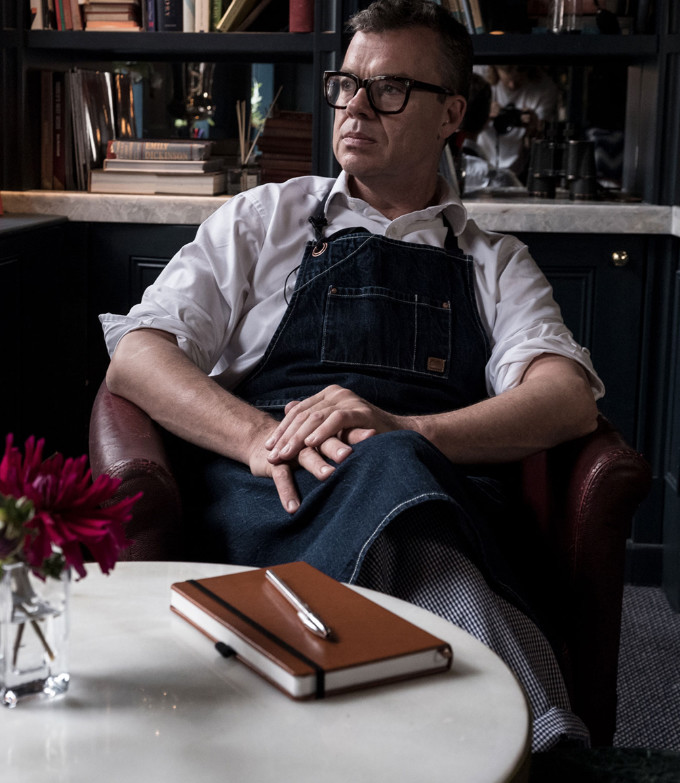


In this three-part essay, chef Andrew Wong takes us deep into the life-force that is dim sum. From its roots in Guangdong to his own attempts to channel its magic at his London restaurant.
What we’ve tried to do over the last twelve years is get people to question their preconceptions of what Chinese food is: what it can be and what it stands for, culturally.
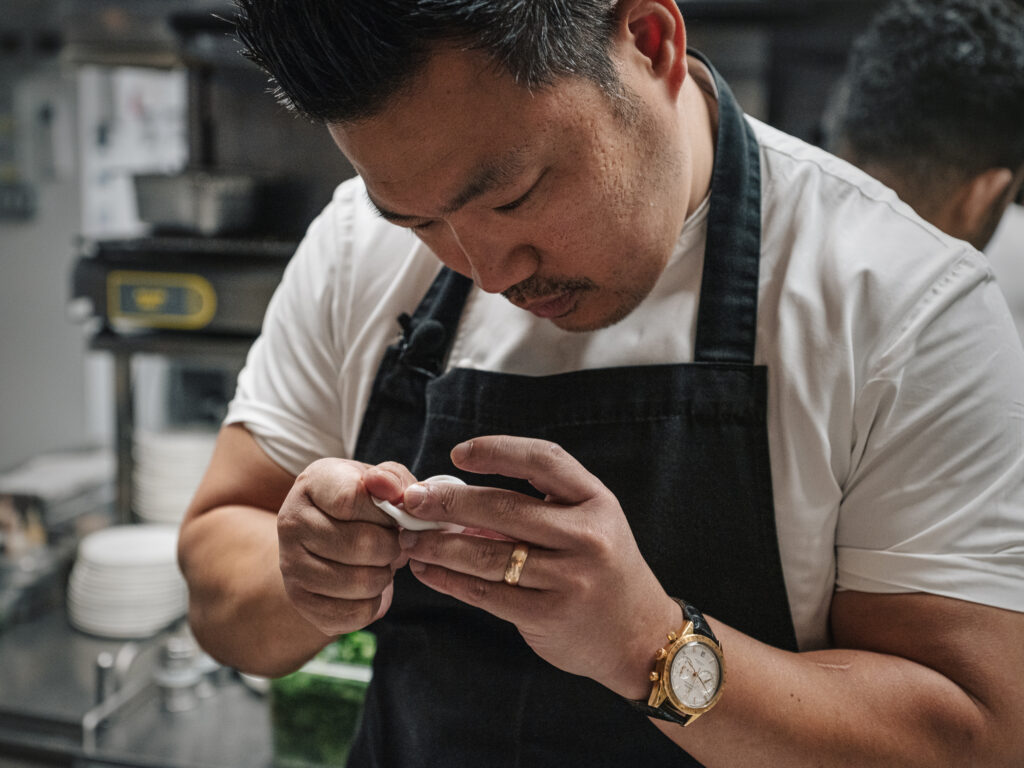
A lot of people have a very superficial understanding of what dim sum is. In the UK, it may be that thing you eat on a Saturday afternoon; in Australia it’s dim sum on a Sunday. In North America, it means something different again.
But at no point in time has it ever stood for artisanal expertise, incredible dexterity, or as being a skill that one would relate to that of a European pastry chef, for example.
And yet, in some ways, I think the Chinese repertoire has a lot more diversity. At my London restaurant, A Wong, where we don’t have a massive dim sum menu, we use twenty five starches, we have ten flours – which we are endlessly manipulating to achieve different textural sensations.
If you look at the language that is available to describe western pastry versus the adjectives used to describe mouthfeel in a Chinese dim sum kitchen, there is no comparison.
We talk about how it rolls around your tongue, about achieving that elusive sensation of crispness with added crumbliness and snap. When we talk about prawns, for example, we use a specific word that means crispness, or crunchiness. We don’t have those adjectives to describe seafood in the English language.
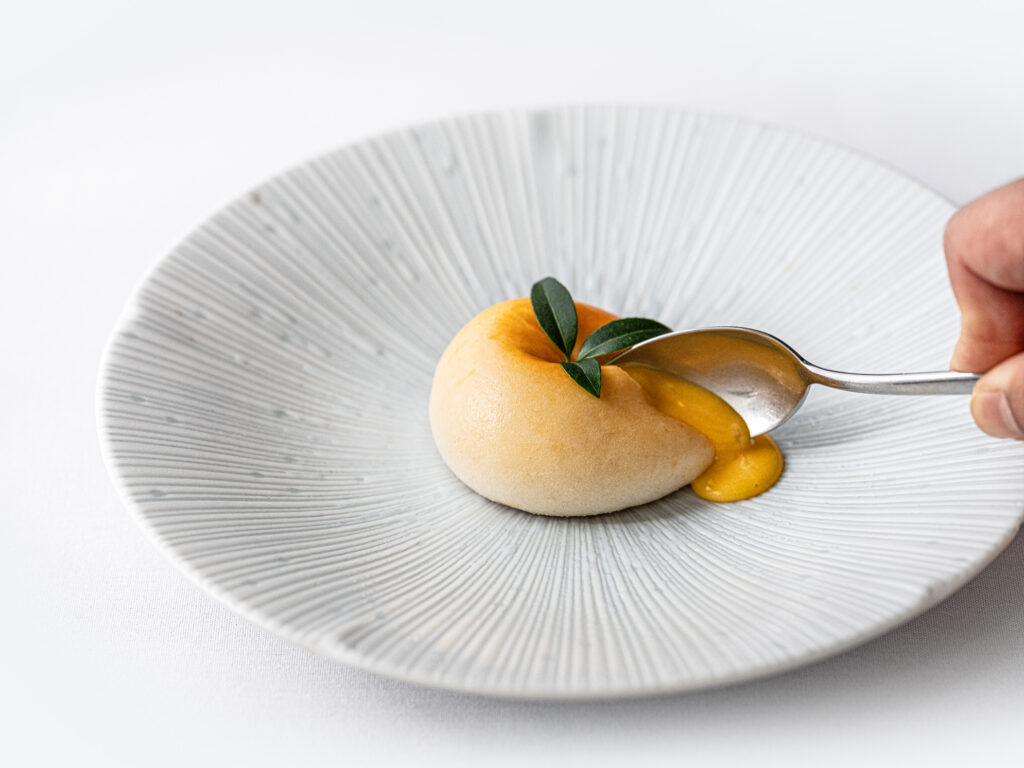
To begin to understand dim sum, you need to know two things. First, its roots. Now, dim sum arguably goes back thousands of years and a lot of people will tell you it originated in tea houses across China as a means to sate travellers. And that’s all part of it. But the other story, and the one I use as inspiration, goes back to the 1800s where in Guangdong, South China, middlemen were connecting British traders with spice and silk traders from India and the Middle East.
These middlemen, some of the richest in history, understood that to look after these traders, to keep them happy, they would need to provide them with the finest food. After sending the message out, chefs soon began to pour in from all over China. Dim sum, as we know it today, is what emerged.
The second thing to know is that in a Chinese kitchen there isn’t a clear demarcation between sweet and savoury. We have a lot of savoury dishes with an immense amount of sugar in them and we have a lot of savoury things that go at the end of a meal. So there’s no pastry section as such, that’s a western construct. Instead, you have dim sum chefs who take care of both with incredible levels of technique, precision, and feel for their craft.
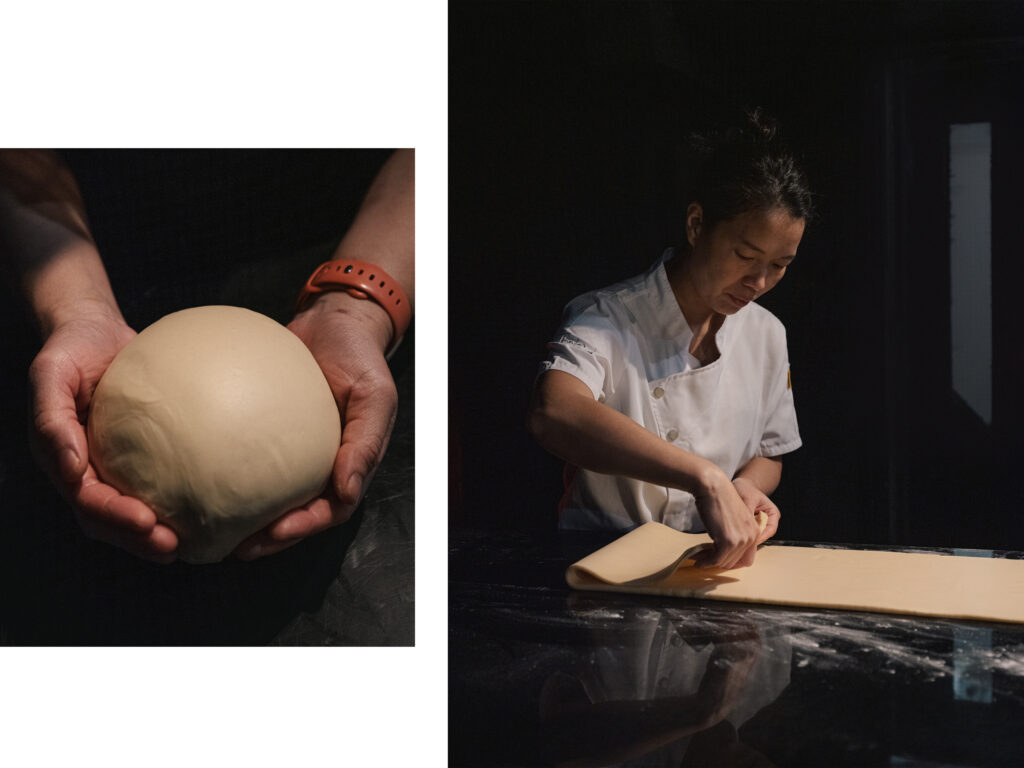
Why is dim sum cookery often overlooked? Chinese gastronomy, when it’s been taken out of China, has been its own worst enemy at times. There’s been a sense of opening food businesses for functional purposes, to give your kids an education, to give your family a better life moving to a foreign land.
And that means a lot of the time you have to be more flexible, you have to cook to your clientele, and you can’t push the boat too far because there are cultural disparities.
Really, only a small minority of restaurants that have moved out of China, out of Hong Kong or Guangdong, have had the prime objective of really celebrating the incredible skill and nuance that exists in the Chinese kitchen.
– – –
People outside of China often think of dim sum as a static entity. Actually, dim sum is always evolving. Go into mainland China, go into Guangdong: thousands upon thousands of types of dim sum are constantly emerging; new ideas, some of them very kitsch, others of the moment.
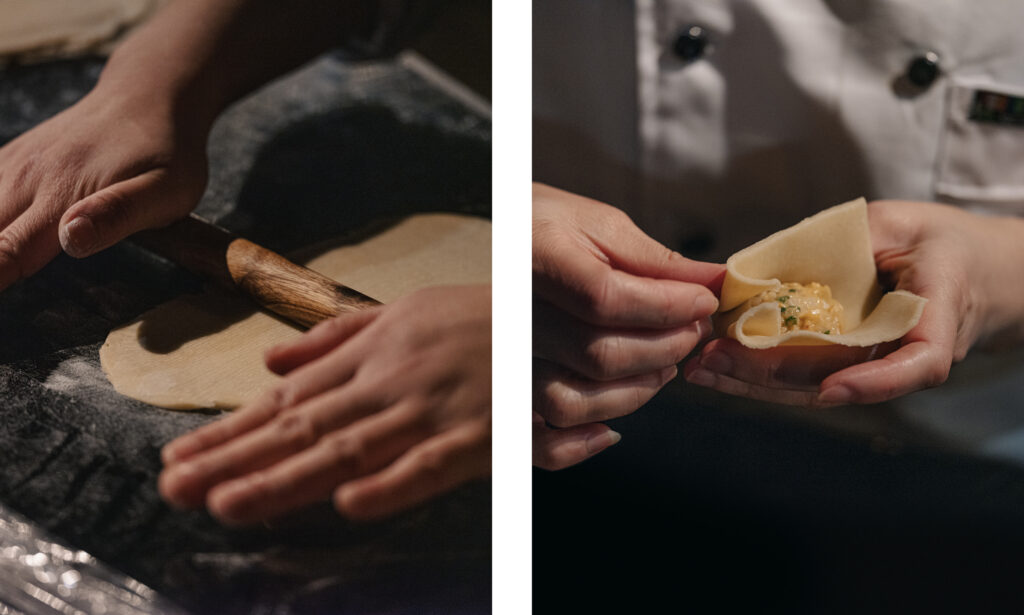
When we opened the restaurant over a decade ago, the driving force behind the menu was to try and collate together all of my favourite dim sums. That idea came from my own experiences of eating dim sum growing up, but also from a formative trip to China in my early twenties where I spent time in different kitchens and regions.
Originally I was meant to go with my cousin in the US, also a chef, but he bailed on me last minute! I carried that energy across the whole trip: just take it as it comes, embrace everything you can.
I’m not going to lie, Chinese kitchens can be closed places. You can’t just walk in and go, “Hi, I want to spend time in your kitchen” – they don’t really like it. It’s very much a more traditional approach to apprenticeship where you’re meant to spend years and years respecting your master before they give you the lessons and techniques.
Luckily, I had friends in kitchens who invited me in. One conversation led to another; you’d spend a week here, a week there. Someone would take you to a noodle place and you’d get talking to the owner there – say, I really like the way you pull noodles. You’d buy them a pack of cigarettes – a box, actually! – and you’d go and learn from them. I had an open itinerary, it was all very organic.
I started in Sichuan, where I made the mistake of saying to a chef that he cooked Chinese food. He snapped back: “I don’t cook Chinese food. I’m a Sichuanese chef and I cook Sichuanese food.” That really epitomised their approach.
From there I went to Qingdao, where they make the beer, to work in my friend’s dim sum kitchen. I went to Beijing for a bit, did all the touristy things, and spent some time in Malaysia and Hong Kong, where the kitchens are a lot more structured.
I went to this one place where I asked the restaurant to recommend something. They sent me this big massive bowl, it literally looked like pond water with a mushroom floating in the middle. And I ate it and it tasted like pond water! The chef told me I was eating it all wrong, that the soup wasn’t designed to be eaten as a single entity but as a palate cleanser to the other dishes on the table.
That experience helped me to understand the idea of eating collectively. In the West you’re brought up to think balance is achieved through a single plate of food. But the essence of a Chinese meal is not just about one dish with some rice. It’s about eating that dish with the crunchy texture of a cold pickle, together with an umami-heavy dish with a base of fermented bean curd, for example, and a softer dish with dried salted nuts. All that together with the jasmine rice becomes the experience as opposed to a single dish.
It’s all part of what I call the energy of dim sum – the vibe you get when you walk into that dining experience. The gastronomic overload and interaction. Not just with the other people eating but with your own tastebuds.
It’s taken me a long time to get this restaurant to a place where we reflect that spirit. And it’s an ongoing process. I go back to China every year. Either we’ll do an event or we’ll go and hang out with some friends in the industry and share ideas. Inspiration is everywhere.
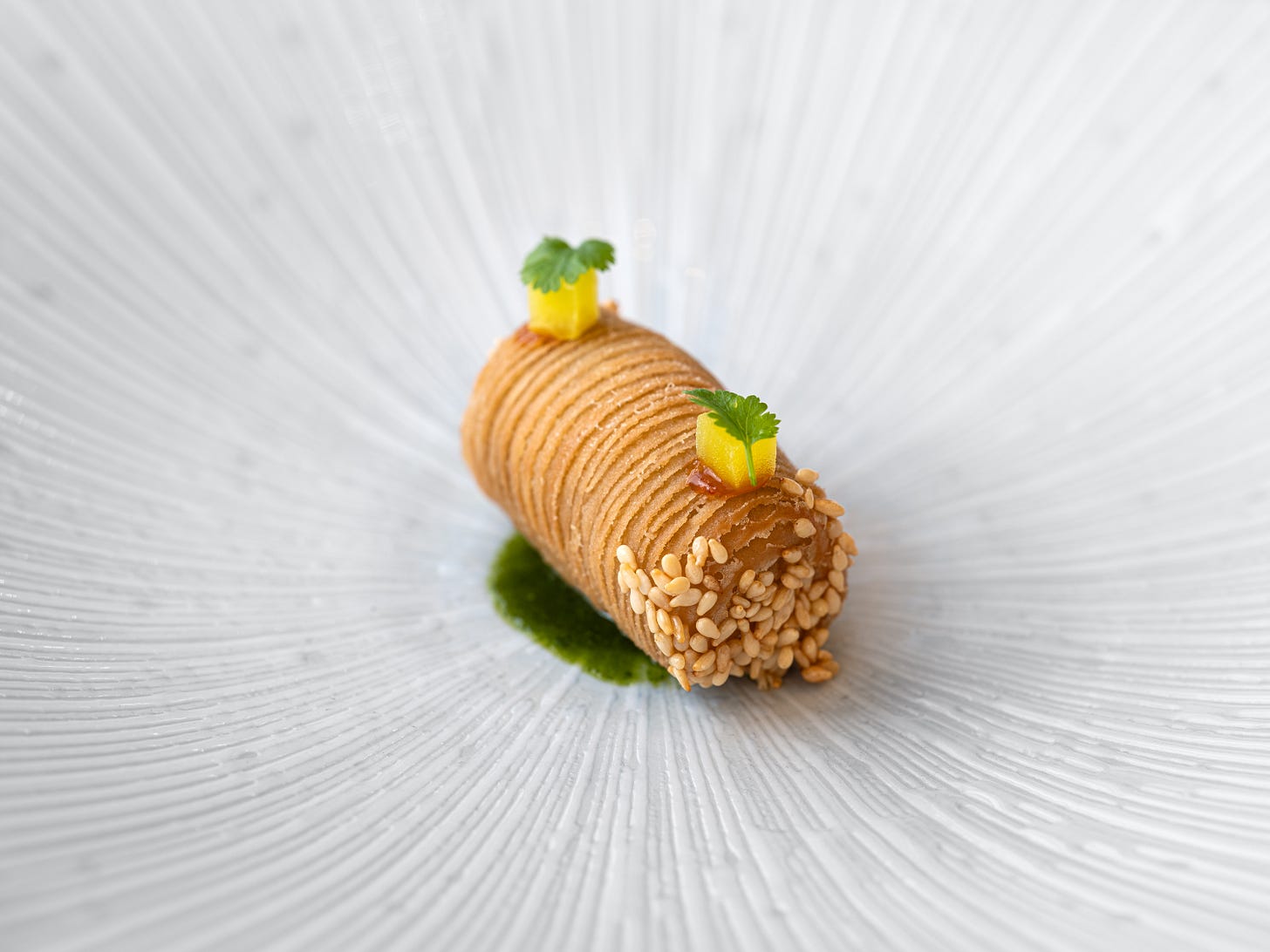
Over the years, I’ve become more and more comfortable about what we do. I never actually tell people that we’re a Chinese restaurant. We’re A Wong. We cook our cuisine and that cuisine is obviously going to be influenced by me as the chef and obviously what influences me is my heritage, the food that I want to celebrate.
And although, cooking in London, I have a different perspective on Chinese cuisine, I do think it’s important to celebrate and document it. We’re living in an age now where technology is omitting a lot of jobs in the kitchen. Unless you share this knowledge it will be lost forever.
The approach in the East, in Chinese kitchens, is moving in that direction but it’s still considerably behind. There, it’s not as common to drop a chef a line and ask them how they do something. They’ll most likely want to know: who are you? Do I trust you? Are you a friend?
In fact, I did an event recently with a chef in China and there was something that I really liked about his kitchen. I texted him, “Hey, how did you do that?” He didn’t reply to me directly, instead he sent me back this famous Chinese poem by a poet called Su Dongpo, the originator of Dongpo Pork:
To what should we compare to human life?
It should be compared to a wild goose trampling on the snow.
The snow retains for a moment the imprint of its feet.
The goose flies away, no one knows where.
Basically, what he was trying to say, in a nice, friendly way, was: we did an event, it was lovely, now fuck off!
– – –
The dim sum dishes on our menu at A Wong are the result of years and years of development. Unfortunately, there is no mathematical formula; food is so much more complex than that.
Three dim sums, in particular, embody the journey we have been on.
Shanghai Dumpling
The Shanghai dumpling is a very classical part of the dim sum repertoire, even though it doesn’t originate from Hong Kong or Guangdong. In Shanghai, they’re served as street food or canteen food in the cold winters. They’re there to fill you up: the pastry is traditionally quite thick and there’s a soup in the middle which you suck out.
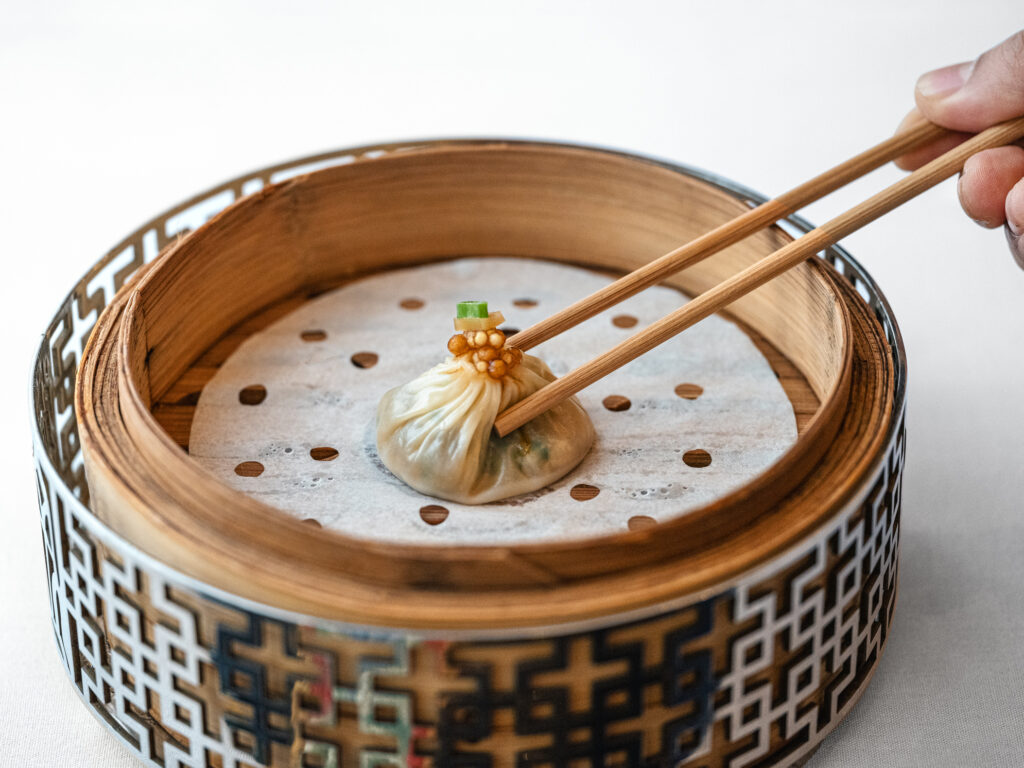
There was this incredible brand in Taiwan that reinvented the Shanghai dumpling. They made the skin thinner, kept the amount of flavour in the soup, and turned it into this one-bite piece of gastronomic perfection. We took that as a starting point and only recently have we got to the point where ours is on a par with it.
The key elements are the pastry, filling, and vinegar dip. You start with the pastry. First, you need to establish your flour and the level of gluten within it. Now, it’s a balance because the higher your gluten content the more watertight it will be, but it will also make it harder for your chefs to roll out.
If you use a flour with too high a level of gluten you might end up losing three or four dim sum chefs – it bruises and marks your hands when you roll out hundreds a day as we do.
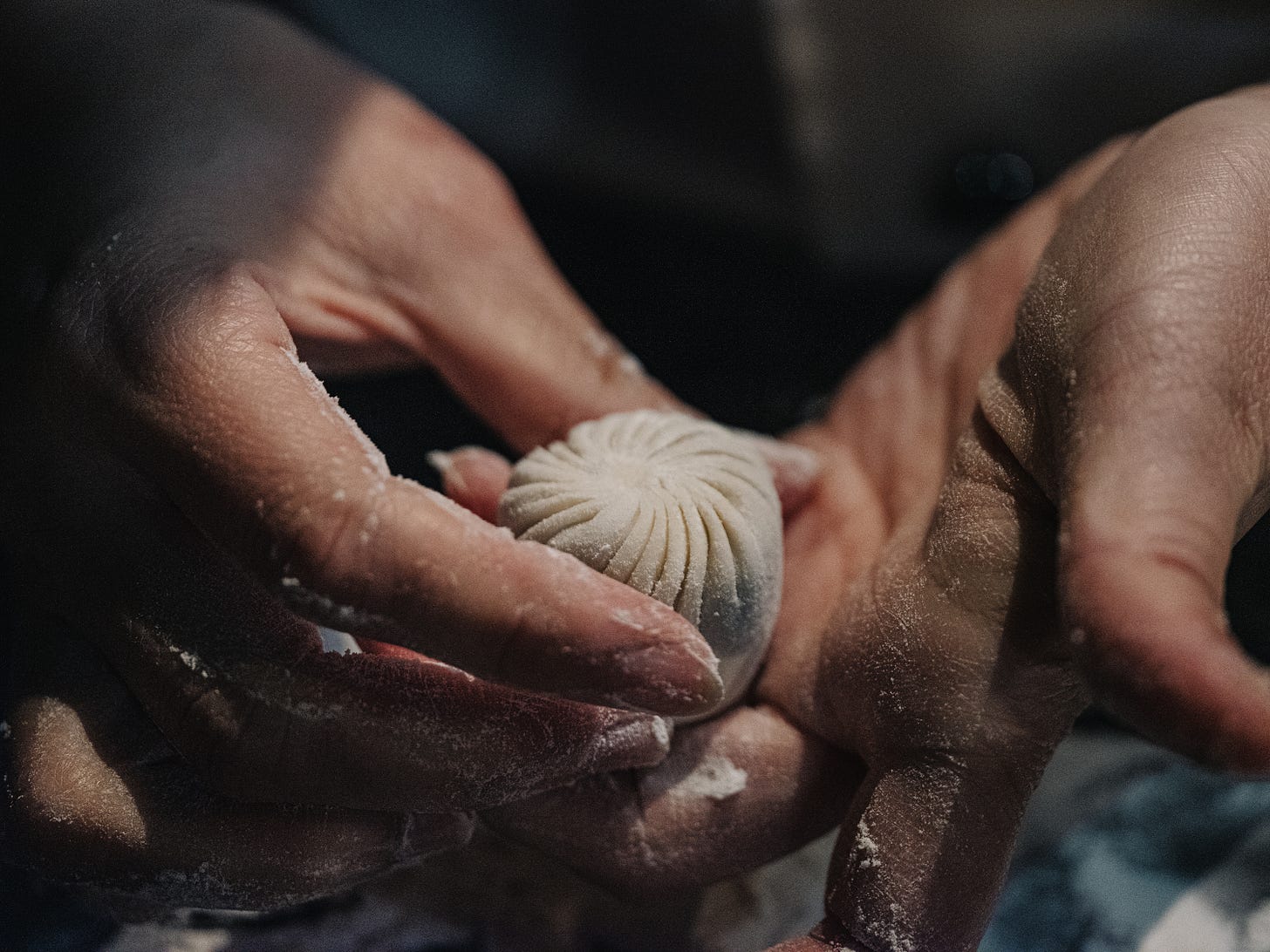
Also, when you wrap it you won’t get the elasticity, those beautiful pleats. Right now, we’re using a high-gluten flour from Hong Kong but it changes throughout the year.
Chinese flours don’t come with a metric measurement so you have to familiarise yourself with a certain brand and go from there, altering the amounts and blends according to the time of year and levels of humidity and temperature in the kitchen.
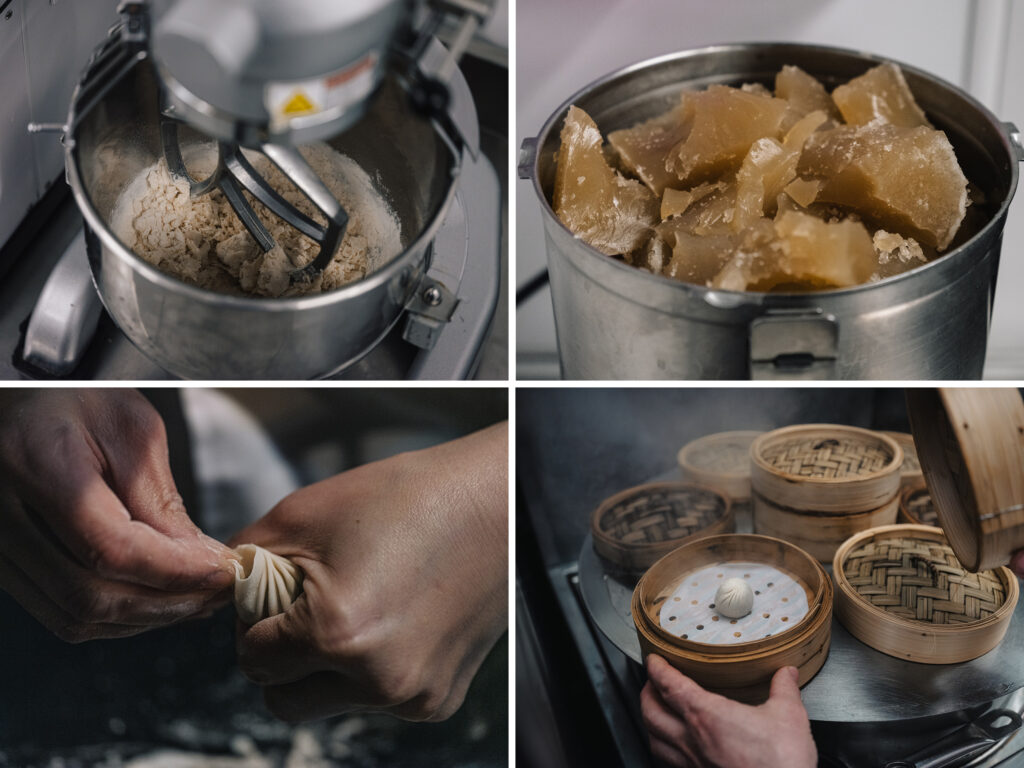
You also need to think about the temperature of the water added to the flour. Same thing: we’re talking about how much firmness you want in the dough versus how watertight you want it to be with the soup inside. Once that’s been added and the dough is there, we laminate it about 30-40 times to work the gluten and get the right amount of elasticity.
With the filling, it’s all about flavour. Traditionally, it’s made by making a soup base and then setting with gelatine or by making a soup base with natural gelatine from pig’s trotters. We use the first method and very recently have started to add ham fat and ham bone to give it more umami.
Once you’ve made the stock, you add your mince. With this, it’s all about the delicateness of the meat and how well it integrates and breaks into your mouth. You don’t want to have a big meatball, that’s not particularly pleasant in my opinion. It’s also about what you marinate the meat in, whether you add Chinese chives, spring onion, and things like white pepper and starch.
Our dumplings are 27g each; 6g of pastry and 21g of the filling. The ratio of filling to jelly should be exactly 70:30. We wrap them with 18 pleats – I was told it has to be 18 as that number is very important in China.
Finally, there’s the vinegar dip. Now, I always find it annoying when you pop the dumpling into the vinegar and the flavour of the soup gets lost. So what we do is inject the vinegar – made up of two different types of vinegar and infused with ginger – into the dumpling.
When you cook it for 4 minutes it creates something very special. You get the hot, umaminess of the soup with the gelatine that coats your lips, the texture of the pastry, and then the vinegar, which washes it all away with a slight sweetness and hit of ginger.
Prawn Dumpling
Our prawn dumpling uses a starch-based dough. We mix potato starch, tapioca starch, and wheat starch and add hot water (around 85 degrees is perfect) and a little bit of oil. Then we knead it until it becomes very elastic and malleable.
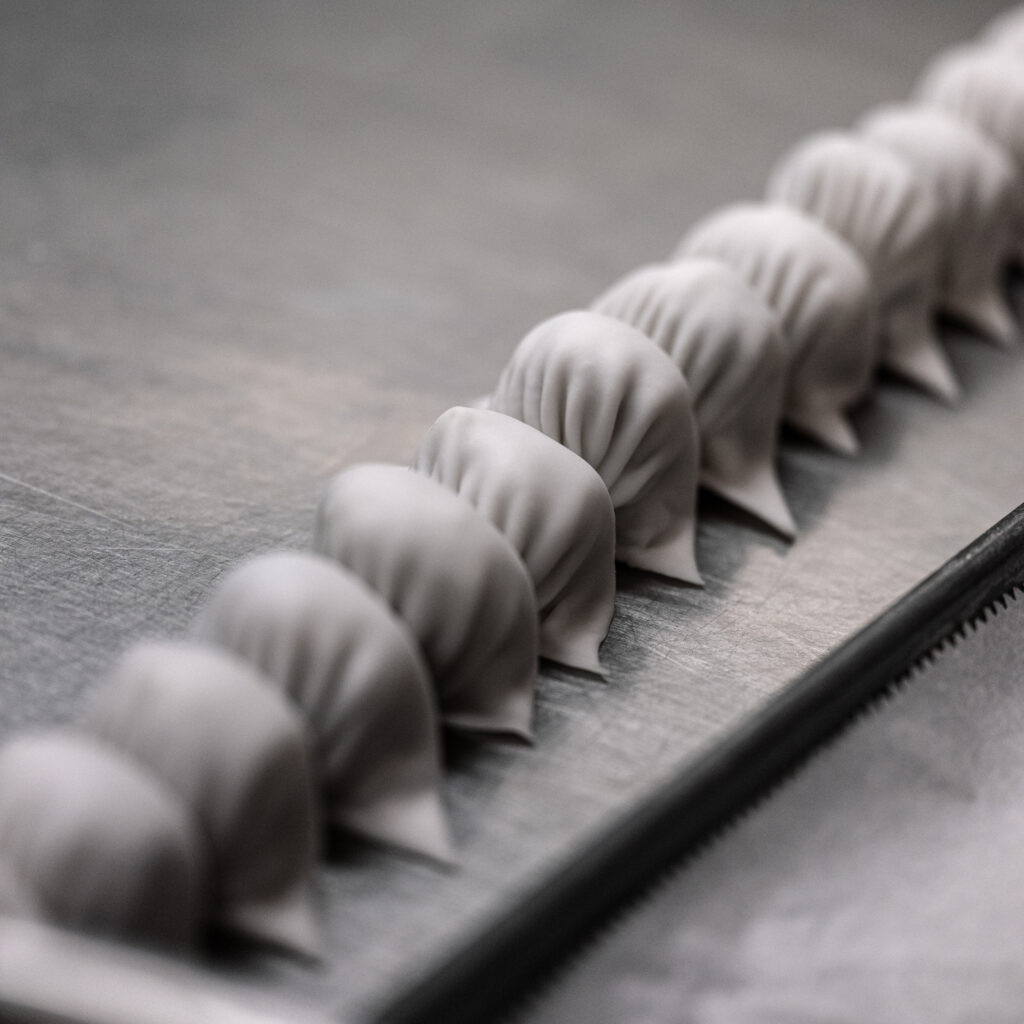
Once that’s done, we need to get moving as the dough will dry out very quickly. Each dumpling is 8g of dough and we use a cleaver to open it out so it’s a circle approximately 10cm in diameter. To that, we add the filling: a set mixture of flour, prawns, potato starch, and seasonings – sugar, salt, white pepper, Chinese rice wine.
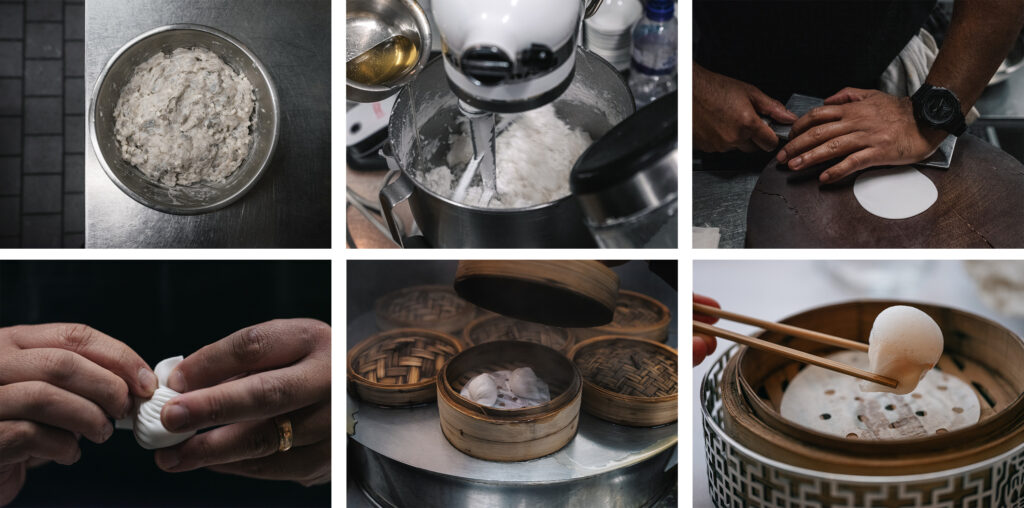
The important part of preparing the filling is to beat it with a dough paddle, rather than blending it in a mixer. What that does is basically whisk the surface of the prawns – rather than just blending them into a puree – which, helped by the potato starch, creates the bouncy texture you are looking for. We wrap the mixture into the dough and pleat it 13 times to create the dumpling before steaming it for service.
Custard Tart
When I was working in Qingdao, I came across this custard tart that was just perfect. I knew I had to find a way of replicating it. The custard itself is pretty standard: egg with sugar syrup and sometimes a little bit of custard powder and evaporated milk. But the pastry needs to have a very distinct mouthfeel.
To achieve this, you make layers which are really neat and distinct. Not like puff pastry where you cut into it and the layers are all over the place – it needs to puff up just enough to be really light in the mouth, but at the same time there needs to be a level of crumbliness to it.
Whereas puff pastry is crunch, crunch, crunch, crunch, crunch – this is crumbly, crunch, crunch, crunch, crumbly. That’s the best way I can describe it. Almost like pieces of filo that have been stuck together.
So we have two pastries. The first is a combination of several types of flour, together with a little bit of fat and sugar. The second, which has a similar effect as the block of butter in a traditional puff, is a combination of butter, oil, whether that be lard or vegetable fat, and more flour for additional crumbliness.
Some people like to put baking powder into it but I don’t feel like that adds much. We use this one to wrap the other, the inverse of puff pastry, and then chill it.
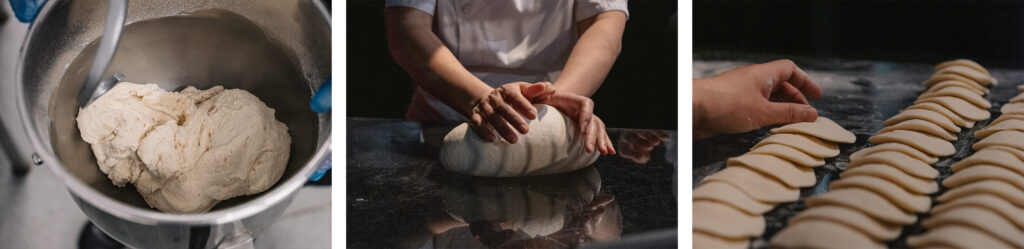
Then it’s about the number of folds. We tried loads of different combinations but settled for a four, three, three fold. If not, you’ll either have a pastry that puffs too much out of the tart or you end up with just too much pastry.
Traditionally, it’s made without a blind-bake. The problem with that is that if you put all the liquid in and bake it straight away, the bottom layer doesn’t puff at all. Which I think ruins the mouthfeel.
So we’re blind-baking it; the base puffs up a little bit, you add the egg mixture in and then you bake it again very, very quickly otherwise the egg mixture will start leaking through the layers.
People might look at it and think it’s just a custard tart. And that happens a lot with Chinese gastronomy: people don’t think about the layers of flavour that exist and the work that has gone into creating even one of those layers. By breaking it down, you can see Chinese gastronomy in a completely different way.
By Andrew Wong, as told to Isaac Parham
Photography by Stefan Johnson & Sarah Bennett